
If you want more Florida buyers and sellers to find you on Google in 2026, the answer is a four-pillar system: a fully built Google Business Profile, location pages for every community you serve, content that answers the questions buyers actually type, and a technically fast website underneath it all. Agents who run all four pillars together dominate their metro; agents who run one pillar at a time wonder why nothing works.
This guide is the complete playbook we use with Florida real estate professionals — the same order, the same priorities, the same weekly rhythm. Bookmark it; every section links to deeper dives on this blog.
Pillar 1: Your Google Business Profile is your storefront
For most 'realtor near me' searches, Google shows three businesses in the Map Pack before any website. Your Google Business Profile is what competes there — and most agent profiles are half-empty: one category, no services, photos from move-in day. A complete profile with the right primary category, buyer-intent service descriptions, weekly posts and a growing photo library is the single highest-impact afternoon you can spend on your visibility.
Reviews are the second half of this pillar. What moves the Map Pack is not your total review count but review velocity and specificity: fresh reviews every month that name the communities you serve. Build the review ask into your closing process and respond to every single one.
Pillar 2: Location pages that prove you are local
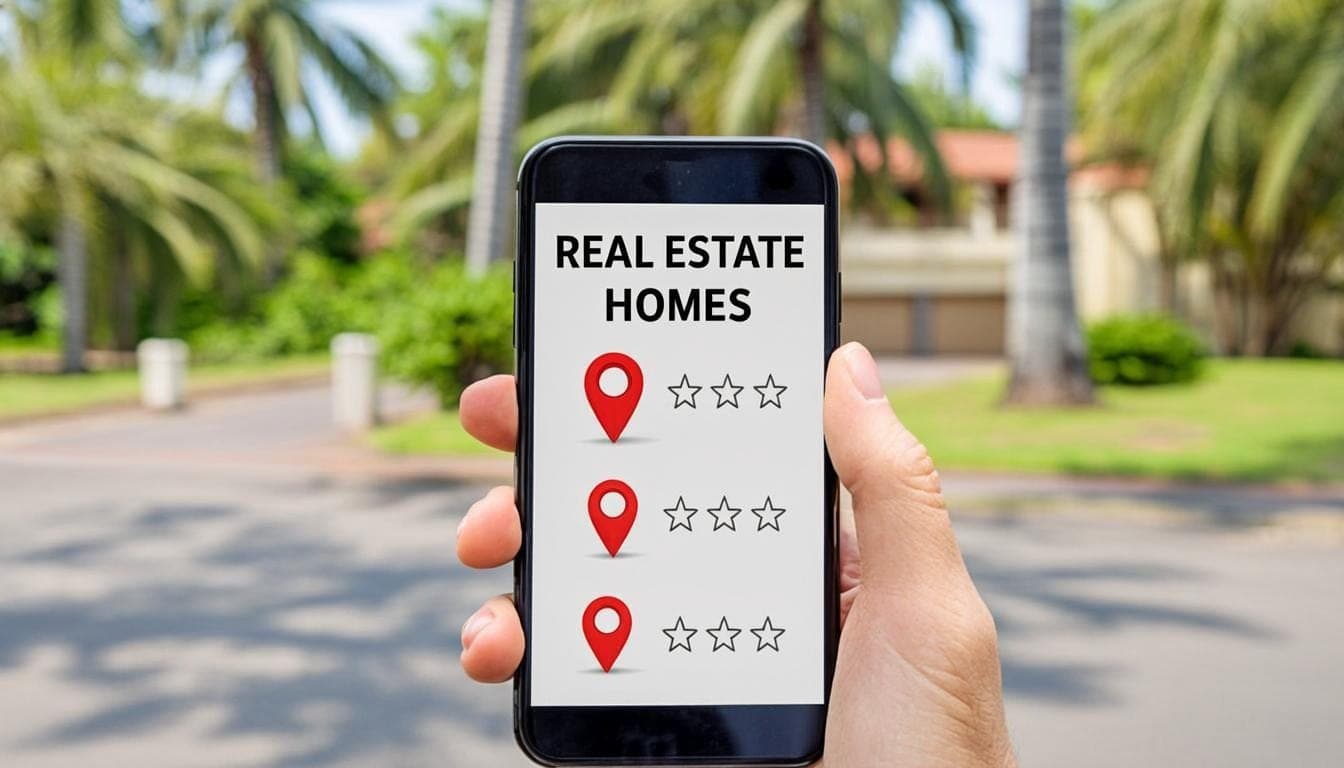
One homepage cannot make Google believe you are relevant to ten different communities. Dedicated location pages — real, specific content about the neighborhoods, buildings and county markets you actually serve — teach Google exactly where to place you on the map. This is how agents start appearing for 'homes for sale in [community]' and 'best realtor in [city]' searches.
The trap is thin pages: 150 templated words with the city name swapped. Google ignores that pattern completely. Write what only a genuine local could write — real landmarks, honest market texture, specific subdivisions — and give every market page a clear next step to contact you.
Pillar 3: Content that answers buyer questions
Florida buyers search questions before they search for agents: insurance costs, flood zones, HOA rules, best months to buy, snowbird timing, condo regulations. Every substantive answer you publish is a page that can rank for years — and every page builds the trust that turns a reader into a call.
This content now has a second audience: AI assistants. When a buyer asks ChatGPT or Google's AI Overviews about buying in your market, the AI assembles its answer from passages like yours. Answer-first writing — the direct answer in the first two sentences, depth underneath — is what gets quoted and cited.
Pillar 4: A fast, technically clean website
Everything above rests on the machine underneath: a website that loads fast on mobile, has clean page structure, canonical URLs, an XML sitemap and no bloated IDX widgets dragging every page down. Google measures Core Web Vitals on every URL, and buyers abandon slow listing pages on cellular connections.
Most real estate sites we audit carry two or three scripts nobody uses and images at five times the size a phone needs. Image optimization and widget cleanup alone typically transform load times — and with them, both rankings and conversions.
The weekly rhythm that compounds
SEO is not a one-time project; it is a rhythm. Our working cadence for Florida agents: weekly GBP posts and photos, two new content pieces a month against your market's seasonal calendar, a monthly review push tied to closings, and a quarterly technical checkup. Twelve months of that rhythm puts an agent ahead of 90% of their local competition — because most competitors do nothing between closings.
Start with an audit so you know which pillar is weakest today, then work the rhythm. Compounding does the rest.

Frequently Asked Questions
How long does SEO take for a Florida realtor?
Expect early movement in 60–90 days on low-competition community searches, and meaningful lead-flow impact in 6–12 months on competitive metro terms. SEO compounds: unlike paid ads, every page you rank keeps working after you stop spending.
Is SEO or Google Ads better for real estate agents?
They do different jobs. Ads produce leads this week and stop the moment you stop paying; SEO builds an asset that produces leads for years. Most Florida agents we work with run ads for immediate pipeline while SEO compounds underneath — then gradually rebalance toward organic.
Do I need a blog to rank as a realtor in Florida?
You need substantive pages that answer buyer and seller questions — whether you call it a blog or guides. Community guides, insurance explainers and market updates are exactly what Florida buyers search, and what AI assistants quote when recommending local agents.
What is the fastest SEO win for a new agent?
A fully built Google Business Profile with correct categories, honest service areas, weekly posts and a review routine. The Map Pack rewards complete, active profiles faster than it rewards new websites — and it drives phone calls directly.
How do I get my real estate website indexed by Google?
Publish a clean XML sitemap and submit it in Google Search Console, make sure no page carries a noindex tag, and link new pages from your homepage and related content. A professionally built site ships with all of this already in place.
That is the complete playbook — but knowing the pillars and running them weekly are different jobs. MrGeek Digital builds and runs SEO systems exclusively for Florida real estate professionals. Request your free SEO audit and we will show you exactly which pillar is holding your visibility back today.
Comments
Comments are reviewed by our team before they appear. We never publish your email address.
No comments yet — be the first to share your thoughts.